
Following the US removal of Maduro in Venezuela, Colombia prepares with concern.
Colombia, a neighboring nation of Venezuela, might experience spillover unrest as a result of the dramatic change in events, which included both violence and a large influx of refugees.
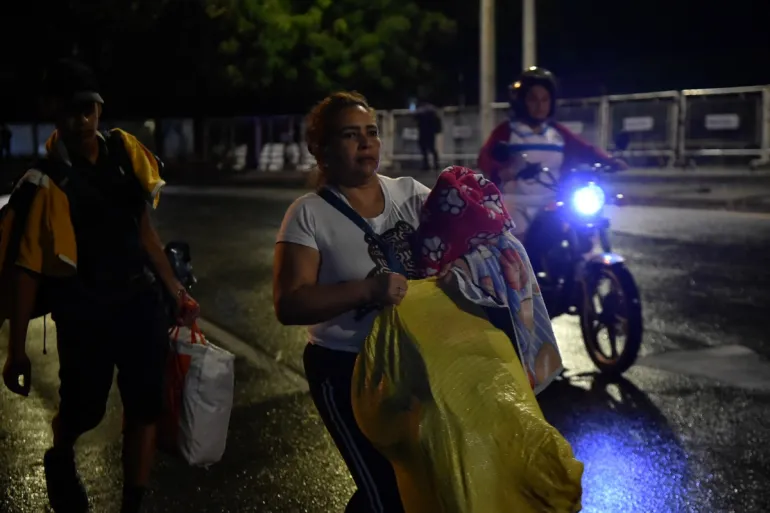
On January 3, 2026, Venezuelans fleeing their nation arrived at the border crossing in Cucuta, Colombia, following a significant US military attack on the South American nation that resulted in the arrest of Venezuelan leader Nicolas Maduro.
After US troops carried out a ‘large scale strike’ on the South American nation on January 3, 2026, and seized Venezuelan President Nicolas Maduro, Venezuelans fleeing their nation arrived at the border crossing in Cucuta, Colombia. The US military’s sudden removal of Venezuelan President Nicolas Maduro has raised concerns in neighboring Colombia, where experts predict the potential for far-reaching consequences.
The Colombian government denounced Washington’s early Saturday morning strikes against Venezuela, which included strikes on military objectives and Maduro’s arrest, and said that it intended to strengthen its 2,219-kilometer (1,378-mile) eastern land border, a historically volatile area for rebellion and cocaine manufacture.
According to refugee advocacy groups, Colombia would bear the brunt of potential migration waves brought on by the intervention’s aftermath, and security analysts also claim that Maduro’s deposition might make an already worsening security situation in the nation worse.
According to President Gustavo Petro, the Colombian government convened an emergency national security session at 3 a. m. (09:00 GMT).
The president tweeted an X post stating that the Colombian government “condemns the assault on the sovereignty of Venezuela and Latin America” and that state forces have been mobilized to protect the border.
The ELN element
The National Liberation Army (ELN), a left-wing organization and the biggest remaining rebel force in the nation, has been outspoken in its plans to protect the nation against “imperialist intervention,” as recently as December.
Following the strikes, the main threat to Colombia’s national security, according to security experts, comes from ELN, which dominates practically the whole border with Venezuela.
“I believe there is a significant chance right now that the ELN may contemplate retaliation, including in Colombia, against Western targets,” said Elizabeth Dickinson, deputy director for Latin America at Crisis Group International.
Analysts claim that the rebel organization, which is heavily engaged in cocaine trafficking and operates on both sides of the border, has profited from ties with the Maduro administration, and that US intervention poses a threat to its international operations.
The ELN, which portrays itself as a bulwark against American imperialism in the area, had previously intensified its use of violence in retaliation for the White House’s threats against Colombia and Venezuela. It bombed state facilities throughout Colombia in December and issued a stay-at-home order to Colombians in retaliation for what it claimed was US aggression.
In anticipation of a potential reprisal attack by the ELN after Maduro’s ouster, the Colombian government has increased security measures. According to a statement released by Colombia’s Ministry of Defense on Saturday morning, “all capabilities of the security forces have been activated to protect the population, strategic assets, embassies, military and police units, among others, as well as to prevent any attempted terrorist action by transnational criminal organizations, such as the ELN cartel. “
“Massive influx of refugees”
Colombia would also bear the brunt of any migration crisis brought on by a conflict in Venezuela, in addition to concerns about rising violence.
Petro stated in an X post on Saturday morning that the government had increased humanitarian measures along its eastern border, adding, “all the assistance resources at our disposal have been deployed in case of a mass influx of refugees. “
With almost 3 million of the estimated 8 million Venezuelans who have fled the nation, Colombia now hosts the greatest number of refugees from Venezuela anywhere in the globe.In 2019, a large humanitarian effort was needed to care for, feed, and provide medical care to refugees after the previous wave of mass migration, which followed opposition leader Juan Guaido’s failed attempt to topple Maduro.
With Colombia losing about 70% of all humanitarian funding following the Trump administration’s closure of its USAID operations in the nation last year, such a procedure is likely to be much more difficult now.
Juan Carlos Viloria, a leader of the Venezuelan diaspora in Colombia, said, “There is a real possibility of short-term population movement, both precautionary and forced, especially if instability, reprisals, or power vacuums emerge. “
“Colombia must prepare proactively by activating protection mechanisms, humanitarian corridors, and asylum systems, not only to respond to potential arrivals, but to prevent chaos and human rights violations at the border,” Viloria added.
A deterioration in the relationship between the United States and Colombia.
Since Trump assumed office last year, Maduro’s expulsion has presented Petro, who has been at odds with the US president, with serious challenges, according to analysts.
In recent months, the Colombian president provoked Trump’s anger by criticizing the military buildup in the Caribbean and claiming that a Colombian fisherman had been murdered in territorial seas. Trump retaliated by calling Petro a “thug” and “an illegal drug dealer” and imposing sanctions on him.
“Right now, Petro is irritable because he no longer sees Trump and his threats as empty, but as real possibilities,” said Sergio Guzman, Director of the Bogotá-based security consulting firm Colombia Risk Analysis.
In fact, Trump has suggested bombing drug manufacturing facilities in Colombia on several occasions. But considering the White House’s history of collaboration with Colombian security forces, authorities predict that the White House is unlikely to act alone.
In spite of Petro’s criticism of Washington’s involvement in Venezuela, he had previously referred to Maduro as a “dictator” and sided with the US and other countries in not accepting the strongman’s fraudulent re-election as president in 2024.The Colombian president has put himself in the position of protecting national sovereignty and international law, as opposed to endorsing Maduro.
Only days after Colombia became a temporary member of the United Nations Security Council, Petro requested an emergency session of the body on Saturday.
In an X message, the president stated, “Colombia reiterates its unwavering dedication to the principles enshrined in the Charter of the United Nations. “