
On 3 June 1989, the voice that had reshaped Iran fell silent. Ayatollah Ruhollah Khomeini — the architect of the 1979 Islamic Revolution and Supreme Leader of the Islamic Republic — died at 86. What followed was not merely a funeral. It was an eruption of collective grief so vast, so uncontrollable, that it became one of the most chaotic and emotionally overwhelming public mourning ceremonies of the twentieth century.
For ten years, Khomeini had towered over Iran as both spiritual authority and political ruler. To his followers, he was more than a statesman — he was the embodiment of resistance, piety and national sovereignty. His death struck a population still shaped by the trauma of revolution and the Iran-Iraq War. Within hours of the announcement, Iran was engulfed in mourning.

The Beginning of National Grief
The announcement of Khomeini’s death triggered a wave of raw emotion across the country. State radio interrupted programming with Qur’anic recitations and sombre music. Mosques filled. Streets in Tehran and provincial cities alike swelled with black-clad mourners. Government offices shut down; shops closed voluntarily.
Television images showed men beating their chests in rhythm, women wailing openly, and elderly clerics weeping without restraint. Many Iranians had grown up knowing no leader but Khomeini. He had returned from exile in 1979 to a nation in revolutionary fever; now he departed amid another tidal wave of public emotion.
Forty days of official mourning were declared. Black banners stretched across highways. His portrait — stern gaze beneath a black turban — was draped over buildings and bridges. For the Islamic Republic, this was not simply the death of a head of state; it was the passing of its founding father.
The Gathering of Millions
On 4 June, his body was placed in a refrigerated casket at the Musalla prayer ground in Tehran to allow the public to pay respects. What followed defied logistical planning. Estimates suggest that millions converged on the capital — some sources place the figure as high as ten million — creating one of the largest funeral gatherings in modern history.
Tehran’s highways were paralysed. Families walked for miles under the June heat. Buses were abandoned. Helicopters hovered overhead as the sea of humanity surged forward in waves.
The atmosphere was electric and volatile. It was grief stripped of restraint. Mourners pushed and fainted. Security forces struggled to maintain order. Yet the desire to be close — physically close — to the man many believed had altered their destiny proved irresistible.
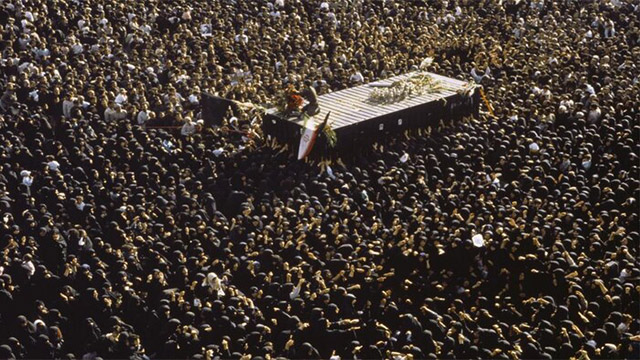
The Helicopter Incident and the mob frenzy
The authorities initially attempted to transport the body to the Behesht-e Zahra cemetery by helicopter, hoping to avoid the crush of the crowd. But the plan collapsed almost immediately.
As the coffin was carried toward the burial site, the crowd surged beyond control. Mourners broke through security barriers. The casket was overwhelmed. In a moment that stunned observers worldwide, the body was pulled from the coffin by desperate hands reaching to touch, to kiss, to claim proximity to their leader one last time.
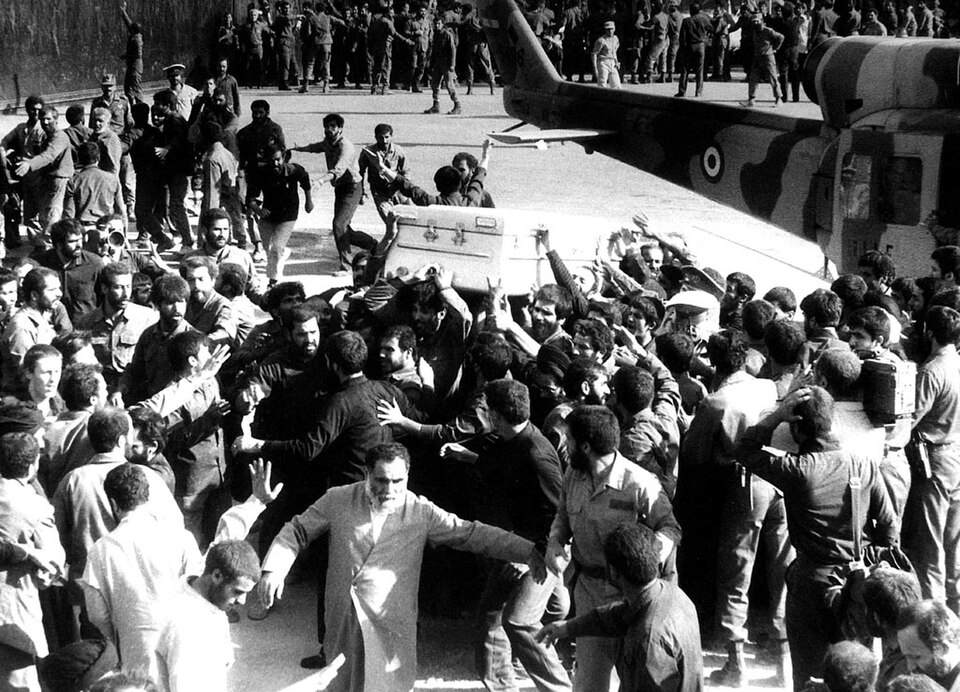
In the chaos, Khomeini’s burial shroud was torn. His clothes were ripped. Television footage showed guards frantically attempting to shield the remains as the crowd surged like a tidal wave. The coffin was nearly overturned; some mourners fainted beneath the crush. It was grief transformed into delirium.
The situation deteriorated so rapidly that security officials aborted the burial. Revolutionary Guards fired shots into the air to disperse the crowd. The body was hastily retrieved. According to accounts from those present, it was carried away and placed back into an aircraft to prevent further desecration or harm. The funeral had spiralled beyond state control.
For a regime built on mass mobilisation, this was mobilisation untamed.
Regrouping the Nation
Authorities postponed the burial. The spectacle of the day—broadcast internationally—shocked many, but within Iran it was interpreted as proof of devotion. Still, order had to be restored.
The following day, 5 June 1989, preparations were tightened. Additional Revolutionary Guard units were deployed. Barriers were reinforced. The burial site at Behesht-e Zahra was secured with far greater discipline.
This time, the ceremony proceeded with more structure, though the crowds remained enormous. Khomeini was finally laid to rest in a simple grave in the cemetery south of Tehran, not far from the martyrs of the Iran-Iraq War — a symbolic placement linking his leadership to national sacrifice.
Yet the simplicity of the initial burial would not endure.
The Tomb: From Grave to Monument
Almost immediately, plans began to construct a mausoleum befitting the founder of the Islamic Republic. What emerged over the following years was not merely a tomb but a vast architectural complex — part shrine, part national monument.
The Mausoleum of Ayatollah Khomeini, located near Behesht-e Zahra, grew into an immense structure crowned with a golden dome and flanked by towering minarets. Marble courtyards, prayer halls and expansive plazas were added to accommodate pilgrims and official ceremonies.
The scale of the complex reflected more than reverence. It was an assertion of permanence. The Islamic Republic would enshrine its founder physically and symbolically at the heart of its national narrative.
The tomb became a site of annual commemoration. Each year on 3 June, officials, clerics and citizens gather to mark the anniversary of his death. His successor, Ayatollah Ali Khamenei, frequently delivered speeches there, reinforcing continuity between founder and heir.
The mausoleum also served a protective function. The chaos of the initial funeral underscored the need to secure the remains. The reinforced structure, guarded and monitored, ensured that the body would never again be subject to the uncontrollable passion that had nearly overwhelmed it.
A Funeral That Reflected a Revolution
The delirium of Khomeini’s funeral mirrored the fervour of the revolution he led. Both were moments when mass emotion eclipsed institutional control. Both revealed the depth of popular mobilisation — and its volatility.
To supporters, the scenes of millions flooding Tehran demonstrated authentic devotion. To critics, they symbolised a nation gripped by political mysticism. Either way, the funeral marked a decisive turning point.
Within hours of his death, the Assembly of Experts appointed Ayatollah Ali Khamenei as Supreme Leader, ensuring that the system Khomeini built would survive him. But no successor could replicate the revolutionary charisma of the original figure.
The frenzy at the funeral was, in many ways, the last uncontested moment of unified revolutionary emotion. In the decades that followed, Iran would experience reformist movements, crackdowns, generational shifts and ideological fractures. But in June 1989, the nation moved — literally and figuratively — as one mass of grief.
The Meaning of the Delirium
What engulfed Tehran was not staged choreography. It was uncontrolled, visceral and at times dangerous. The tearing of the shroud, the scrambling of guards, the helicopter aborted mid-mission — these were not scripted images. They were the consequences of unfiltered mourning colliding with the limits of state power.
The military’s decision to retrieve the body and withdraw it by air symbolised a sobering reality: even the most revolutionary regimes must sometimes retreat before the emotional force of the very people who sustain them.
Khomeini’s death closed the founding chapter of the Islamic Republic. His burial—first chaotic, then monumental—encapsulated the paradox of his legacy: a movement born of popular fervour that ultimately required institutional control to endure.
More than three decades later, the footage of that funeral still shocks. Millions in black, surging toward a coffin. Guards struggling. Helicopters lifting away. A nation caught between sanctity and disorder.
It was grief on a scale rarely seen in modern history — delirium in devotion — and a moment when Iran revealed both the power and the peril of mass faith in a single man.