
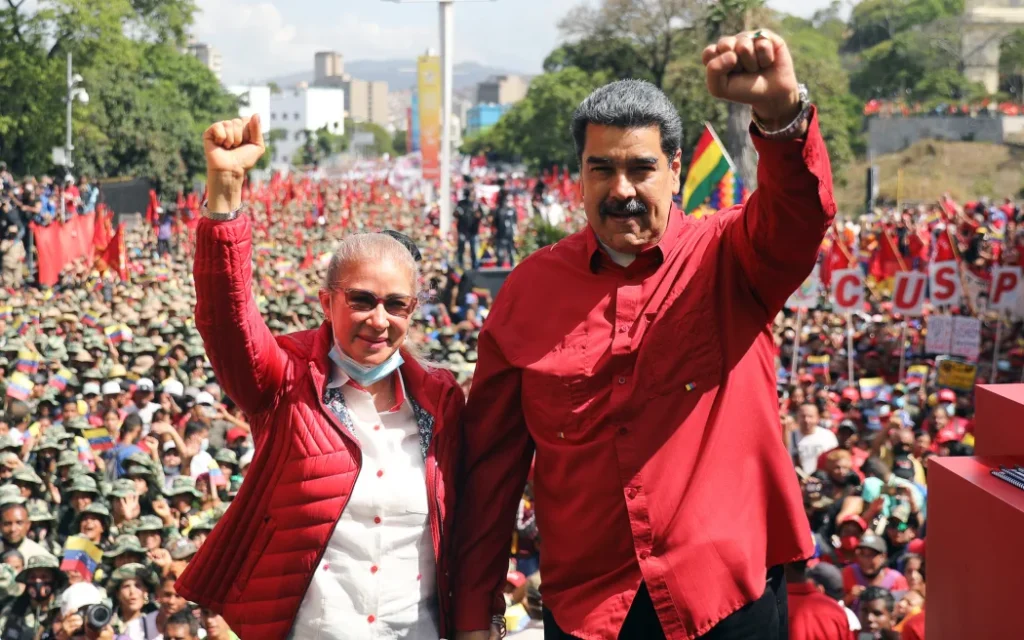
On Saturday, 3rd January 2026, US President Donald J. Trump informed the world that Venezuelan President Nicolás Maduro Moros and his wife, Cilia Adela Flores De Maduro, had been captured by a special US operation force. Maduro had served as the 46th President of Venezuela from 2013 to 2026, when he was overthrown on January 3rd.
Nicolás Maduro Moros (born 23 November 1962) is a Venezuelan politician and former union leader who served as the 46th president of Venezuela from 2013 until his capture and overthrow on January 3rd 2026. He served as the Vice President under President Hugo Chavez from 2012 to 2013, and minister of foreign affairs from 2006 to 2012.
233today.com takes a walk through his life from his birth through his presidency to his eventual capture and overthrow by the Donald Trump-led US government on 3rd January 2026.
Nicolás Maduro Moros
1. Birth and Early Childhood
Nicolás Maduro Moros was born on November 23, 1962, in the bustling neighbourhoods of Caracas, Venezuela, into a modest working-class family. His father, a labour activist involved in leftist politics, introduced the young Maduro to social causes early in life, instilling a deep connection to the labour movement and grassroots politics.
Growing up amid Venezuela’s complex mix of oil wealth and urban struggle shaped his worldview from an early age—the disparities and contradictions of Venezuelan social life would follow him into adulthood.
Maduro’s upbringing was humble but politically charged, and he became active in student activism at an early age, eventually being expelled from high school for organizing protests before finishing his secondary education later
2. Education and Formative Years
Maduro’s path diverged from a traditional academic career: after high school he did not pursue a university degree, instead throwing himself into political training and union work. In 1986–87 he attended a political training school in Havana, Cuba — the Escuela Nacional de Cuadros Julio Antonio Mella — where he studied Marxist theory, political economy, and revolutionary tactics under Cuban Communist Party instructors.
Back in Caracas, Maduro worked as a bus driver for the Metro company, founding an unofficial union that challenged company policies and built his reputation as a labour organiser. This union activism connected him with other leftist movements and put him on the path toward national politics, especially through his early support for Hugo Chávez’s release from prison in the early 1990s.
3. Rise to Power and Prominence
Maduro’s political ascent was deeply tied to Hugo Chávez and the Bolivarian Revolution. After Chávez’s failed coup in 1992 and subsequent imprisonment, Maduro and his future wife, Cilia Flores, campaigned for his freedom, cementing an early bond with Chávez’s movement.
In 1999 Maduro was elected to the National Constituent Assembly that rewrote Venezuela’s constitution, a cornerstone of Chávez’s political project. He later served as a deputy in Venezuela’s National Assembly, rising to become its president by 2005.
Chávez appointed him Foreign Minister in 2006, where Maduro championed alliances across Latin America, Africa, and the Middle East. He was selected as Chávez’s vice president in 2012 and, after Chávez’s death in March 2013, became interim president and won a narrow special election weeks later.
4. Presidency and the Making of a Controversial Leader
Once president, Maduro faced enormous challenges. Venezuela’s economy, heavily dependent on oil, was hit by falling prices and shrinking production. Hyperinflation, shortages of food and medicine, and deep poverty became defining realities of daily life for Venezuelans. Millions left the country in search of better opportunities abroad.
Politically, Maduro’s years were marked by crackdowns on protests, contested elections, and consolidation of power. Critics described the 2018 and 2024 elections as fraudulent and raised alarm over the erosion of democratic institutions. Opposition leaders were jailed, exiled, or barred from politics; this further polarized Venezuelan society.
Maduro was sworn in for a third term in January 2025 amid international criticism—a moment that dramatically heightened tensions with Western countries.
5. The Dictator of Venezuela
To many observers — both inside and outside Venezuela—Maduro’s governance by the mid-2020s had shifted from a troubled presidency to authoritarian rule. Human rights groups accused his government of serious abuses, including suppression of dissent, political persecution, and harassment of journalists and activists.
Economic management was widely seen as disastrous; basic goods became scarce, and inflation soared to among the highest in the world. While Maduro maintained the loyalty of the military and portions of the poor urban electorate, many Venezuelans saw their livelihoods — and hopes for democratic renewal — disappear
For critics, these trends cemented Maduro’s reputation as dictator of Venezuela — an image amplified by alliances with other authoritarian governments and his control over state institutions.
6. Feud with the US
Relations with the United States deteriorated steadily over more than a decade. The U.S. government repeatedly accused Maduro’s regime of corruption, narcotrafficking, and undermining democracy. In 2020 the U.S. Justice Department indicted him on narco-terrorism and other charges and placed a multi-million-dollar bounty for his arrest — a list that grew dramatically over time.
Maduro, for his part, cast U.S. pressure as imperialism, accusing Washington of seeking to seize Venezuela’s vast oil and mineral wealth. Diplomatic ties were broken, diplomats expelled, and sanctions tightened — setting the stage for the most serious confrontation yet between the two nations.
7. Capture And The End of An Era
In a dramatic and historic turn in early January 2026, U.S. President Donald Trump announced that American forces had captured Nicolás Maduro and his wife following a military operation in Caracas. This came after months of escalating pressure, including two hemispheric bounties, maritime strikes, and diplomatic isolation.
The reported operation — involving strikes on key military targets and elite units — led to worldwide shock, debate, and outcry. Supporters of Maduro denounced the action as a violation of sovereignty; critics hailed it as the end of authoritarian rule in Venezuela. Leaders across Latin America, Europe, and Asia weighed in on the legality and consequences of the move.
U.S. officials have indicated Maduro will face charges related to drug trafficking and corruption in American courts, while Venezuelan authorities have demanded proof and condemned the intervention.