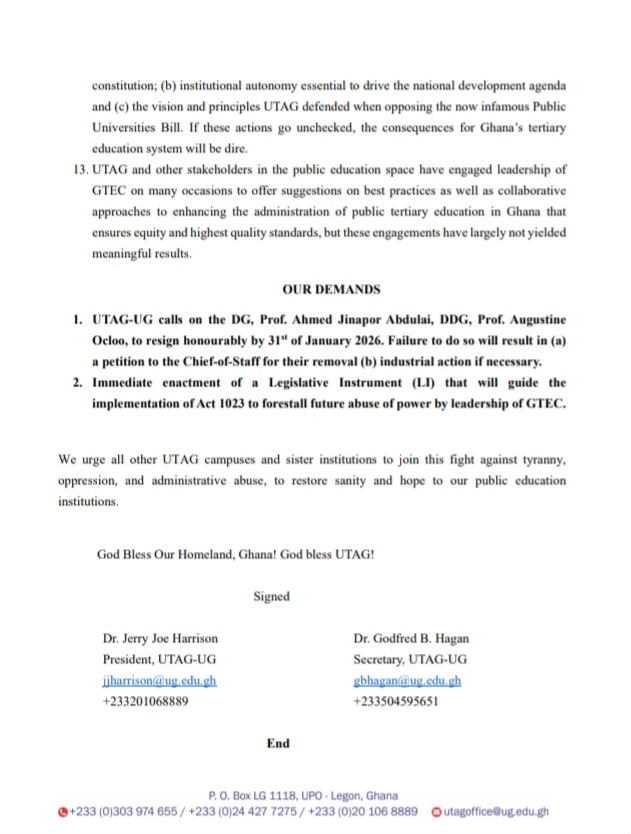
Lecturers at the University of Ghana have called for the immediate resignation of the Director-General and Deputy Director-General of the Ghana Tertiary Education Commission (GTEC), accusing the leadership of incompetence and exceeding its legal mandate.
In a statement issued on Monday, the University Teachers’ Association of Ghana, University of Ghana branch (UTAG-UG), said Prof Ahmed Jinapor Abdulai and Prof Augustine Ocloo should step down by 31 January 2026, or face a formal petition to the Chief of Staff and possible industrial action.
UTAG-UG accused the GTEC leadership of abandoning its core regulatory responsibilities while pursuing what it described as “tangential and sometimes frivolous actions”, including efforts to identify holders of so-called fake degrees, at the expense of deeper systemic problems in tertiary education.
“The quality of education in public tertiary institutions is at an all-time low due to insufficient funding, poor infrastructure and inadequate remuneration for lecturers, yet GTEC appears indifferent to these challenges,” the statement said.
The lecturers also accused GTEC of interfering in the internal governance of universities and undermining the authority of governing councils and vice-chancellors.
They questioned the legal basis for the commission’s role in the removal of the former Vice-Chancellor of the University of Cape Coast, Prof Johnson Nyarko Boampong, challenging GTEC to identify which provision of the Education Regulatory Bodies Act, 2020 (Act 1023) authorised such action.
One of the key grievances cited was a directive issued by GTEC on 1 October 2025, which required lecturers to retire immediately upon reaching the age of 60, rather than at the end of the academic year—a long-standing practice in public universities.
UTAG-UG warned that the directive could disrupt teaching and supervision, particularly where lecturers reach retirement age in the middle of a semester.
The association also criticised what it described as GTEC’s confrontational engagement with university management, pointing to an incident in which Prof Jinapor wrote to the University of Ghana demanding the reversal of an alleged 25% fee increase.
According to UTAG-UG, the report later turned out to be false, and the commission failed to verify the claim before making it public.
The statement further raised concerns about a three-year freeze on recruitment clearance for universities, even to replace staff who have retired, resigned or died, saying the policy has increased workloads and adversely affected teaching and research.
UTAG-UG warned that the conduct of the GTEC leadership threatens academic freedom and institutional autonomy, both of which are protected under Ghana’s 1992 Constitution.
The association also called for the urgent passage of a legislative instrument to guide the implementation of Act 1023, arguing that the absence of clear regulations has enabled abuse of power.
“We urge other UTAG branches and allied institutions to join us in resisting administrative excesses that continue to undermine public tertiary education,” the statement concluded.
GTEC has not yet responded publicly to the allegations