
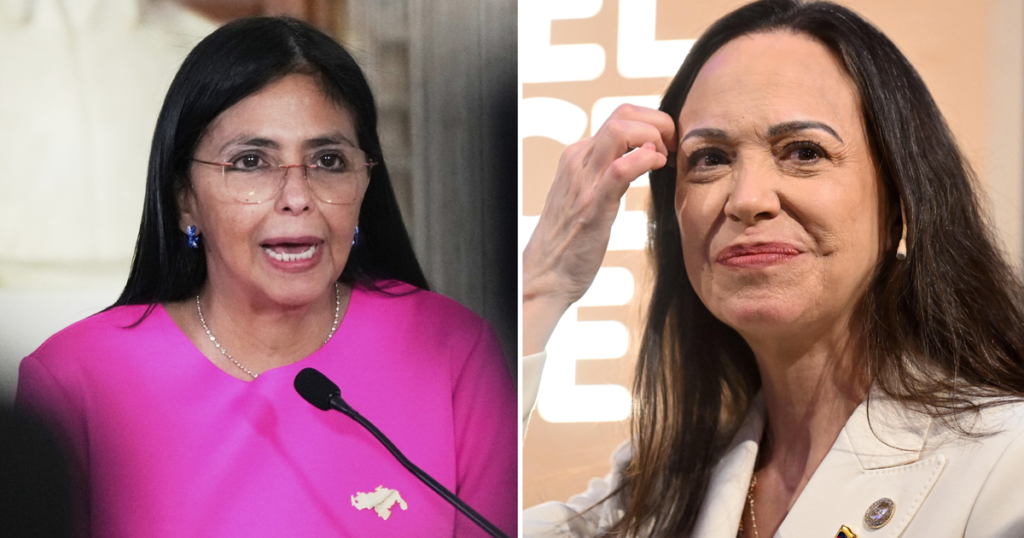
President Trump’s decision to back Delcy Rodríguez—formerly Nicolás Maduro’s vice president—rather than Nobel Peace Prize laureate and pro-democracy activist María Corina Machado as Venezuela’s interim leader was strongly shaped by a confidential CIA assessment.
According to The Wall Street Journal (reported on the 5th), the intelligence agency advised that Rodríguez’s technical background and bureaucratic experience, particularly in the oil sector, made her better suited to ensure short-term stability after Maduro’s arrest and removal. This view was reportedly shared by a small group of senior officials within the Trump administration.
Trump was also frustrated by the Venezuelan opposition’s inability to mount an effective challenge following what he viewed as Maduro’s electoral fraud during his first term. His comments—praising Machado as “very dignified” while arguing that she lacked sufficient public backing—reflected this disappointment.
Although Machado publicly supported U.S. military intervention and sought Washington’s backing, Trump ultimately favored Rodríguez, a hardline socialist aligned with Chávez and Maduro who retained support from entrenched power structures.
In Trump’s assessment, Rodríguez was the more reliable partner for maintaining immediate stability. He made no public commitment regarding future Venezuelan elections, instead emphasizing U.S. strategic influence and oil interests in the country.
As the administration debated post-intervention scenarios, it repeatedly requested CIA input. The agency’s conclusions, combined with Trump’s scepticism about the opposition’s effectiveness, led him to support a former Maduro ally despite the dictator’s removal. Analysts noted that Trump believed stability depended on a leader acceptable to the military and elite institutions.
The CIA report also identified Interior Minister Diosdado Cabello and Defence Minister Vladimir Padrino as key power brokers alongside Rodríguez. While both figures control Venezuela’s police and armed forces, they are under U.S. criminal indictment, making cooperation politically and legally difficult. Nevertheless, the report concluded that without deploying U.S. ground troops—a daunting prospect given Venezuela’s size—any stable transition would require engagement with these actors.
Intelligence analysts further warned that even if opposition figures such as Edmundo González or Machado assumed leadership, establishing legitimacy would be difficult due to the resilience of Maduro-era networks, including military loyalists and drug-trafficking organisations.
Trump’s endorsement of Rodríguez stunned and demoralised the opposition, which had actively courted him. Machado, who had previously defended foreign military intervention and dedicated her Nobel Prize to Trump for his “firm support”, faced criticism at home for advocating external military action.
Following Maduro’s arrest, Machado and González publicly declared their readiness to govern. Until the success of the military operation, Trump and his inner circle had portrayed the opposition as the preferred alternative. Trump had praised Machado as recently as January, while Secretary of State Marco Rubio acknowledged years of dialogue with her.
Ultimately, Trump concluded that the opposition’s past failures—despite sanctions, diplomatic pressure, and U.S. backing—demonstrated its inability to mobilise either the military or the population. In his view, an opposition government would face immediate resistance from security forces, criminal networks, and political rivals.
Juan Cruz, a former senior White House official overseeing South America policy, summarised Trump’s position bluntly: “He sees the Venezuelan opposition as ineffective. They failed to meet expectations—so why transfer power to them?”